En bref
Créée environ un an plus tôt au Tessin, Poseidon Engineering SA propose des études territoriales, géologiques, environnementales et de génie civil. Son responsable technique et commercial, Domenico Pileggi, explique en anglais l’intérêt de la géophysique pour caractériser le sous-sol en complément des forages ponctuels. Les méthodes sismiques renseignent sur la compressibilité et la rigidité des matériaux, les méthodes géoélectriques sur la disposition géolithologique ; non invasives, elles produisent un modèle tridimensionnel du sous-sol. Applicables à faible coût sur des pentes raides, des parois ou des zones très urbanisées, elles peuvent atteindre des centaines de mètres de profondeur. La société a déjà travaillé sur des autoroutes, voies ferrées et aménagements hydroélectriques tessinois.
Texte rédigé avec l'aide de l'IA à partir de l'édition imprimée du magazine. En savoir plus
« The geophysical techniques can be used in any territorial context, at a relatively low cost. »— Domenico Pileggi
L'interview intégrale
Poseidon Engineering SA is a new company which has operated in Ticino for around a year, offering a range of services for issues connected with territorial studies, geology and the performance of environmental and civil engineering work. Dr. Domenico Pileggi, Technical & Business Manager, explains the various benefits that a geophysical approach can offer for correct geognostic characterisation of subsoil.
“The current engineering approach for studying subsoil characteristics uses mechanical drilling in order to precisely define the stratigraphic layout of materials in a single place. However, the footprint of structures in the research or implementation phases often requires a more extensive evaluation of these characteristics. Specifically, we need to know how these vary in different directions and at a different depth. From this perspective, the geophysical techniques can be a great help”.
How is geophysical prospecting carried out?
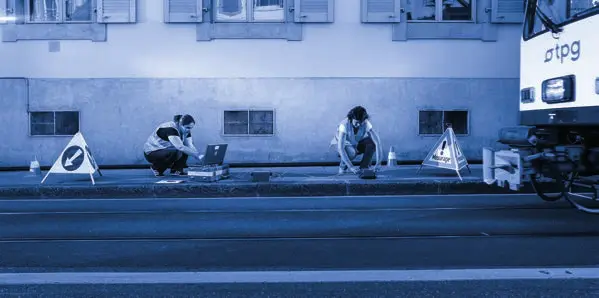
“There are a number of surveying techniques, however the most frequent are seismic and geoelectric. The former is capable of defining the compressibility, deformability and rigidity characteristics of excavation materials, while the latter detects the geo-lithological layout of the subsoil. Both survey types are “non-invasive” and only require the relevant wires and sensors to be placed on the soil surface. The final result is a volumetric, three-dimensional model of the subsoil in which the variations in the geophysical parameters being investigated are illustrated in 3 spatial directions”.
In which contexts is it possible to use this type of prospecting?
“The geophysical techniques can be used in any territorial context, at a relatively low cost. We generally work either in simple morphological situations with the aim of integrating and extending the existing data from drilling or in areas in which other types of surveys cannot be carried out, such as on steep slopes, morphological walls and areas that are heavily anthropised and/or subject to special environmental constraints”.
Who are your main customers?
“The good thing about geophysics is that besides being very easy to apply, it is capable of reaching exploration depths of hundreds of metres, where necessary, while keeping costs at a level that is accessible to everyone; something that is inconceivable to the drilling survey community. This is why all companies whose business involves infrastructural and land works are looking to us in order to optimise performance and costs. Even though Poseidon has only been in existence for a little more than a year, we have already worked on motorways, railways, hydroelectric services and important engineering and geological studies in Ticino”.
Texte paru dans Swiss Knowhow – Grands travaux / Grossprojekte 2016, p. 54. Retranscrit de l'édition imprimée avec une assistance informatique (IA), sans réécriture ; en cas d'écart, la version imprimée fait foi.
Personnes citées
- Domenico PileggiTechnical & Business Manager
Paru dans
Swiss Knowhow – Grands travaux / Grossprojekte 2016
2016 · page 54 · article original en anglais
Signaler une erreur Lire l'article complet PDF